The Other Side of Discovery
At Tufts University, Master’s, PhD, and post-doc students in scientific fields experience deep and rigorous training built around a single space: the laboratory, where their focus is on finding an answer within stocks of data, skillful technique, and compounds or algorithms with unique properties and purposes. Few programs pause to show students the fuller landscape of what happens after these things are done in the lab; the legal, business, and translational work that determines whether a discovery reaches beyond is often glossed over.
The Tech Transfer Intern Program at Tufts was built to fill this gap. Now in its tenth year and based out of the university’s Technology Commercialization (TC), the internship program gives students hands-on exposure to the process of moving research out of the lab and into the world. Interns gain understanding in patent assessments, market evaluation, and licensing strategy, and how they can work in tandem with the scientific backgrounds they’ve spent years building.
“Tech Transfer is particularly interesting because it shows that students can use their scientific background in different directions: there is the legal side, business development, focusing on the translation of technology itself, or even staying in academia to facilitate those translations,” Chiara Vannucci, Licensing Manager at Tufts TC, told us, “We try to provide our interns a picture of what they can do with their backgrounds.”
In order to provide students with this knowledge and understanding, the Tech Transfer Internship program is structured to be part education, part apprenticeship. Throughout the year, the TC office hosts a series of workshops that teach the foundations of tech transfer and protection as well as specific topics such as assessing invention disclosures. One workshop held was led by Filip Čučkov, Director of the Auster Center for Applied Innovation and Research, who walked interns through customer discovery; the session detailed the National Science Foundation’s (NSF) I-Corps methodology and how it applies to evaluating early-stage technology.
Between the workshops and educational aspects, the program focuses on tech transfer in practice. Each intern is assigned a case manager within the office and a project to work on for a few weeks at a time. These projects are usually based around determining whether a new technology, developed in a Tufts lab, is fundable, patentable, or what a good path is for it to move toward commercialization. The work doesn’t stay with each individual intern and their case manager; each intern regularly presents their projects to the full cohort, encouraging group engagement and creative problem-solving. Thus, a technology that one intern may have never encountered turns into an opportunity for the whole room to brainstorm: What could this be used for? Who would want it? What is the smartest way to bring this to market? This is a format that rewards exactly the kind of thinking that doesn’t always have space to develop inside an individual scientist’s lab.
Grace Hamilton, MSIM’26 and 25-26 Tech Transfer Intern, spoke with us about this format: “All of us interns came from different backgrounds and levels of experience, so it was fascinating to see how everyone approached their individual projects. During our presentations, we would constantly bounce ideas off one another, interjecting with fresh lenses and new perspectives. This created a highly collaborative, conversational flow in our meetings that truly enriched our work.”
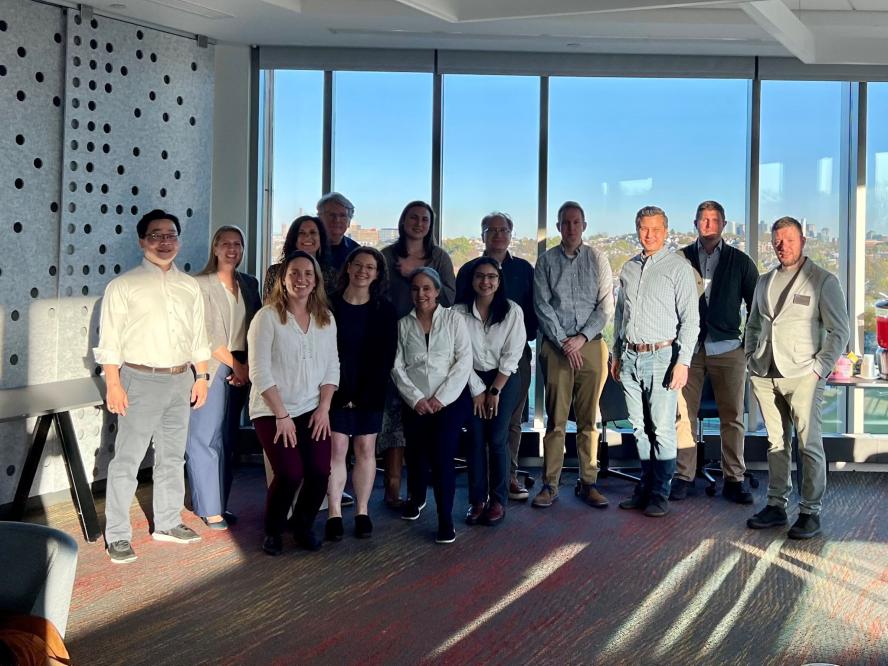
This sense of community and collaboration culminates at the end of the program, when the TC office hosts a networking event that brings together current interns, past interns, and staff who have worked in the Technology Commercialization unit over the years. This event functions as something of an office-wide reunion and is designed with a specific purpose in mind: keeping people connected long after their internships end. For interns, it’s also a rare chance to talk with people who have taken the experience in entirely different directions; from the lab, to other technology transfer offices, to law school, or industry roles that may not have been on their radars prior to this experience.
This spirit of connection and research translation is what draws the Auster Center for Applied Innovation and Research to the work of the Technology Commercialization team and the Tech Transfer Intern Program. The Auster Center exists to support Tufts University researchers in moving discoveries out of the lab and into real-world impact, not just as a matter of policy, but as a practice built on transdisciplinary collaboration and structured methodology. The Tech Transfer Intern Program is a natural extension of that mission, applied not to a single technology, but to the students themselves. Just as a research discovery needs the right combination of legal, business, and translational support to reach its full potential, so do the students working to understand it. The Auster Center’s support of this program reflects a belief that innovation isn’t just about what gets discovered; it’s about equipping the people capable of carrying it forward, in whatever direction that may take them.
This belief is already playing out in the paths former interns have taken – into licensing roles, business development, law, and beyond – each carrying a scientific foundation into work that looks nothing like a lab bench, and everything like real-world impact.
Nina Dinjaski, now Associate Director of Business Development and Licensing at Mass General Brigham Innovation, reflected on how the internship program has directly impacted her career: “The internship in Tufts technology transfer shaped my career and reinforced my passion for bringing innovative discoveries from the lab to patients who need them most. The mentorship and guidance I received from the program leaders provided the foundation for my first role as an Associate Licensing Manager and continued growth in technology transfer, venture investing, and innovation. Their commitment to translating research into real-world impact inspired the mission that continues to guide my work today.”
As the program enters its fourth year, with plans to deepen its work in customer discovery and further expand what interns are exposed to, that map of possibility continues to grow. For the Master’s, PhD, and post-doc students who come through it, the Tech Transfer Intern Program offers something rare: proof that a life built around scientific rigor doesn’t have to end where the lab does; it can lead somewhere entirely new.